| |

Tony Yap & Collaborators |
|
| |
|
 tyc is an ensemble of culturally diverse independent artists. Each artist is accomplished in their individual field of artistic discipline. > The vision is to create a multi-modal form that is intrinsically international in its artistic language. The unique artistic language that we have created makes us effective representing an Australian-Asian experience in the contemporary arts. > The direction for physical dance practice transforms ancient shamanistic practice into a post-modern medium. > tyc foster and continue artistic and creative collaborations in the Asian region and to profile Asian Arts in an international context. They create work that is unique in that it allows evolution: they are constantly looking for a structure that allows spontaneity within structure, work that is always fresh and current and still within the original artistic framework. tyc is an ensemble of culturally diverse independent artists. Each artist is accomplished in their individual field of artistic discipline. > The vision is to create a multi-modal form that is intrinsically international in its artistic language. The unique artistic language that we have created makes us effective representing an Australian-Asian experience in the contemporary arts. > The direction for physical dance practice transforms ancient shamanistic practice into a post-modern medium. > tyc foster and continue artistic and creative collaborations in the Asian region and to profile Asian Arts in an international context. They create work that is unique in that it allows evolution: they are constantly looking for a structure that allows spontaneity within structure, work that is always fresh and current and still within the original artistic framework.
“…exquisite…There are real lessons to be learned from the way Yap builds his work. Each element has its place and is given its time, allowing the audience to reflect and absorb the miltiplicity of meanings....The feeling was profound, the silence palpable.”
St Sebastian - Hilary Crampton, The Age
|
 |
 |
| |
| |
 |
ty+c formaly 'Mixed Company' |
| |
|
| |
In 1993 Tony founded Mixed Company with an ensemble of independent artists from diverse artistic disciplines.
ty+c/Mixed Company remains committed to the exploration and creation of an individual dance theatre language that is informed by psycho-physical research, Asian shamanistic trance dance, Butoh, voice and visual design
Mixed Company produced innovative productions and was fundamentally an experimental physical theatre group. The productions under Tony's artistic direction were highly physical and visual.
Ongoing training and explorational workshops continue to this day. The workshops combines Butoh, physho-physical training methods and Asian shamanistic trance dance.
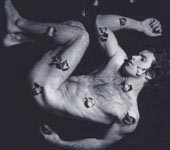
Productions include Icarus, Narcissis's Dream, Print of a Pulse and St Sebastian.
|
|
 |
|
BIOGRAPHY
Tony Yap, born in Malaysia, is an accomplished dancer, director, choreographer and visual artist. Tony was one of the principle performers with IRAA Theatre (1989-1996). He has made a commitment to the exploration and creation of an individual dance theatre language that is informed by psycho-physical research, Asian shamanistic trance dance, Butoh and psycho-vocal experimentations. Tony has received numerous nominations and awards including The Decay of the Angel which won him a Green Room Award for Male Dancer Award; and Rasa Sayang was nominated for The Australian Dance Awards for Outstanding Achievement in Independent Dance. He has been a leading figure in inter-cultural discourse and received Asialink residential grants to work in Indonesia in 2005, and 2008 and a Dance fellowship from the Australia Council for the Arts. Tony is the founding Creative Director of Melaka Arts and Performance Festival – MAP Fest (www.melakafestival.com).
He has contributed significantly to the development of contemporary dance & performance practice, particularly bringing a non-Western perspective to the palette of work being created. His practice is grounded in: Asian philosophies, sensibilities and forms; inter-cultural and multi-disciplinary approaches; ongoing relationships and collaborations that deepen over time; inclusiveness, diversity and individuality; process, evolution and the emergent.
Tony was one of the principle performers with IRAA Theatre (1989-1996) and has worked extensively in Australia and overseas including Agamemnon Festival Colline Torinese, Italy, and The Trojan Woman, Vienna International Art Festival. As the founding Artistic director of Mixed Company (now Tony Yap Company) in 1993. Tony has collaborated with many companies and individual in Australia, Indonesia, Austria, Italy, France, Malaysia, Greece, The Netherlands, Denmark, China, South Korea and Japan. He danced in an international collaborative work in The Silence of the Forest with Company Lian in Paris and The Night Gardener in Marseille for the Mai-diteranee Festival, France.
Tony's contemporary trance praxis has resulted in his recent Phd thesis, Trance-forming Dance.
Creative affliations (selected)
MAP Fest - Melaka Arts and Performance Festival. 2009-present – Creative Director
Experimentum MAP - established 2019. – Creative Director
Creative afffiations with MAP Delhi Festival; Palem Arts Festival (East Java); Bangkok Buffulo Field Festival; Bandung International Arts Festival; Bantengan (Bull-Trance) Carnival (East Java).
Achievements & Awards (selected)
Winner Male Dancer, Green Room Awards. 1999
AsiaLink Residencies: Indonesia. 2005 & 2014
Dance Fellowship, Australia Council for the Arts. 2008
Arts in Asia Awards, Finalist, Melaka Arts & Performance Festival & Kekkai. 2013
Significant Nominations (selected)
OUTSTANDING PERFORMANCE BY A MALE DANCER in Rasa Sayang, Australian Dance Award. 2011
OUTSTANDING ACHIEVEMENT IN INDEPENDENT DANCE for Rasa Sayang, Australian Dance Award. 2011
------------------------------------------------------------------------------------
Click link for COPY of TY+C Manifesto
A MANIFESTO FOR SINGULAR BODIES
Haecceity and the Autonomous Dancer
Tony Yap l March 2026
On thisness, becoming, and the irreproducible event of presence
Dance begins with thisness.
Not the universal body, not the trained body, not the representational body —
but the singular body that appears once, in this precise time and space.
Each dancer carries a haecceity:
a vibration of existence that cannot be duplicated.
Every gesture, pause, tremor, and quiver is the manifestation of singularity.
Movement is not technique alone; it is presence made visible.
§ 01
The Autonomous Dancer
The autonomous dancer is self-originating — understood here in Deleuze and Guattari’s sense of a body without organs: a field of intensities, a plane of immanence from which movement erupts, unissued from any authorial will. To move autonomously is to enter the pre-individual, to let the virtual actualise through flesh.
Technique, in this light, is preparation for dissolution — its true purpose less mastery than clearing. It clears the body of habituated blockage — what Grotowski calls the via negativa — so that movement may arise from the force of the event itself, beyond the reach of the performer’s prior intention. The body becomes a site of becoming rather than being, perpetually differentiating, perpetually arriving at thresholds it cannot anticipate.
“A haecceity has neither beginning nor end, origin nor destination; it is always in the middle. It is not made of points, only of lines.” — Deleuze & Guattari, A Thousand Plateaus
Autonomy is therefore not isolation but radical responsibility: the dancer as the locus through which difference passes and is expressed. Stillness holds potency equal to motion — present as intensive difference, the held breath before differentiation unfolds, rather than as mere absence. Silence contains as much energy as sound.
In the spirit of Butoh, Dionysian trance, and shamanic practice, trembling and quivering are signals of the body opening to forces that exceed it — choreographic discoveries, rather than failures of control. Improvisation is attunement to the field — what Deleuze would call the plane of consistency, the differential milieu from which the dancer draws — rather than mere randomness. Movement arising from possession, rupture, or ecstatic flow becomes a mode of becoming-other: a crossing of the threshold between the dancer’s bounded identity and the unbounded field of affect.
Dance becomes most universal when it becomes most singular. This is the paradox of haecceity: that absolute particularity — this body, this breath, this quiver at this instant — is the very site where the impersonal and the universal pulse through.
· · ✦ · ·
§ 02
Dance as Relational Event
Singularity does not exist in isolation. Following Erika Fischer-Lichte’s concept of the autopoietic feedback loop, performance is a self-generating relational field — an open system constituted by the feedback between moving body, charged space, and receiving witness, rather than a one-directional transmission of meaning from stage to audience.
In Deleuzian terms, the performance event is assemblage: a provisional gathering of heterogeneous elements — body, breath, light, sound, affect, attention — that momentarily cohere into an intensive whole and then disperse. Each element deterritorialises the others. The dancer is simultaneously space, affect, and event. The spectator brings their nervous system, breath, and memory into the choreographic field; witnessing and co-creating become indistinguishable.
The loop: the dancer’s movement inflects the space and those watching. The spectator’s visceral and emotional response — what Massumi calls the autonomy of affect — returns to the dancer, generating new movement, new intensities, new thresholds. This is not communication; it is contagion. Affect is co-choreographer.
Each performance is thus irreproducible — singular in the deepest ontological sense: the event cannot be captured, recorded, or re-enacted. Every equivalence between performances is superficial; the event belongs entirely to the moment of its occurrence: a Deleuzian événement, virtual and actual simultaneously, forever unrepeatable in its happening.
The spectator is observer and co-creator simultaneously. Their presence alters the field; their absence would constitute a different event entirely. Performance is a shared being-in-intensity: a threshold experience that passes through all bodies present and is owned by none.
· · ✦ · ·
§ 03
Flow, Catharsis, and Transformation
Flow is crucial; it is necessary. When haecceity — the thisness of movement — interacts with the affects circulating in the performance field, it may dissolve the rigid stratifications of the body: the armourings of habit, grief, and self-surveillance. What Artaud sought in the Theatre of Cruelty — the physical dissolution of the separation between stage and spectator, the cracking open of the organism — finds its somatic correlate in the trance body: the body surrendered to forces that reorganise it from within.
Catharsis, in this frame, is not Aristotelian purging but Deleuzian destratification — a loosening of the body’s organisation, a release of intensities held captive by stratified identity. Grief may dissolve: the body, in moving, discovers new configurations of itself, new lines of flight that bypass the blockage. Transformation occurs in both dancer and witness, because both are traversed by the same impersonal forces.
Dance becomes ritual in this sense: a structured invitation for transformation, a technology of the threshold. The performance space becomes a liminal zone — what Turner calls communitas, what Deleuze calls a zone of indiscernibility — where the fixed coordinates of self temporarily lose their grip, and something new may be installed in their place.
· · ✦ · ·
§ 04
Principles for Practice
01 Micro-perception: attend to the imperceptible — subtle shifts of weight, the gathering of breath, the tremble of attention. These are not preludes to movement; they are movement.
02 Irreproducible gestures: honour each movement as a singular actualisation of the virtual — unrepeatable, non-recoverable, already past in the instant of its arising.
03 States over steps: cultivate trance, quiver, suspension, and dissolution rather than the execution of codified forms. Let the state produce the step.
04 Minimal environments: elemental, reduced spaces intensify haecceity. Remove the decorative; let the singular body be the only ornament.
05 Intentionality as field: every action carries ritual significance not because of symbolic content but because of the degree of attention brought to it. Intentionality is a quality of presence, not of meaning.
06 Dialogue with spectators: allow affect to flow freely between bodies. Do not manage it; attune to it. The spectator’s involuntary response is a gift to the choreographic field.
07 Flow as necessity: transformation emerges through shared intensity. Do not arrest the flow for the sake of legibility. Meaning follows intensity; it does not precede it.
08 Presence over perfection: technique is preparation for forgetting technique. The body that is most fully present is the body that has ceased to monitor itself.
09 Improvisation as attunement: movement evolves in real-time feedback with the field. There is no score to execute, only a plane of consistency to inhabit.
10 Event over object: each gesture is an emergence — a momentary actualisation of the virtual — not a fixed form to be apprehended and catalogued. Resist the impulse to make dance into product.
· · ✦ · ·
§ 05
Ten Propositions for the Autonomous Dancer
1 Dance is thisness — irreducible, singular, and relational. It belongs to no category; it only ever occurs.
2 The dancer is the site of movement’s actualisation: the body through which the virtual passes into the actual, beyond mere interpretation.
3 Technique liberates the body; affect liberates the event. Without both, there is only demonstration.
4 Stillness and tremor meet at intensive thresholds: the body at the edge of its own dissolution.
5 Improvisation is not the absence of form but the most rigorous attunement to the form the present moment demands — form discovered rather than form imposed.
6 Choreography is a field of haecceities: an open plane through which singular intensities move and collide, alive rather than prescribed.
7 Flow is necessary; catharsis is its gift. Both emerge from the surrender of the performer’s will to the force of the event.
8 Presence matters more than perfection. Perfection closes the body; presence opens it.
9 Performance is ritual, repair, and transformation: it opens the threshold through which the fixed self may pass and return altered — its sacred quality arising from genuine presence, not declared intention.
10 Every gesture is an event in a loop of affect: passing through dancer, spectator, and space, leaving each irrevocably changed and none unchanged.
· · ✦ · ·
§ 06
States of Trance and the Emergence of Affect
In the states of trance, the body becomes a resonant field — vibrating with impulses that precede thought and intention. This is the body as Deleuze and Guattari conceive it: a plane of intensities prior to stratification, open to forces it did not choose and cannot fully govern — organised around living intensity rather than fixed function and meaning. The trance body does not perform; it receives.
Micro-movements emerge spontaneously from this receptive state — tremors, shivers, quivers, suspensions — each carrying a haecceitic signature, a singular presence that cannot be repeated. These are signals of a deeper attunement — the body’s way of registering what Massumi calls pre-personal intensity, the affective charge that runs beneath conscious experience and exceeds it — rather than symptoms of lost control. In trance, perception is heightened precisely because the filtering mechanisms of the trained, self-monitoring body have loosened their grip.
The dancer feels deeply, moves intensely, and radiates energy that is simultaneously inward and outward — a Deleuzian zone of indiscernibility between self and field, between interior impulse and exterior force.
Affect flows between dancer and spectator in an autopoietic loop: emotional and visceral responses are mirrored, amplified, and transformed. The trance is a threshold in the fullest philosophical sense — a zone of becoming where the fixed coordinates of identity temporarily dissolve, opening pathways for catharsis, rupture, and collective recognition, rather than a boundary between two stable states. Blocked energy, held tension, accumulated grief — these may move, dissolve, and transmute, not through narrative resolution but through the sheer force of shared intensity.
In this interplay, both performer and witness participate in shared becoming. The singularity of the dancer — this body, this tremor, this unrepeatable instant — generates ripples of transformation across the relational field. Trance, in this sense, is the most radical form of presence: the body fully opened to the event of its own occurrence — immediate, shared, and singular rather than private or exotic.
· · ✦ · ·
Dance is both threshold and transformation.
It is ritual, catharsis, and revelation.
The autonomous dancer carries the weight and gift of singularity —
and offers it, unreservedly, to the world:
in the irreproducible miracle of the moment,
in the haecceity that was never before and will never come again.
Writen by T Yap, March 2026
------------------------------------------------------------------------------------
Coming Event:
Tony Yap + Collaborators
We respectfully acknowledge the Wurundjiri People of the Kulin Nation who are the Traditional owners of thel land o which we live and pay respect to their elders, past, present and emerging
|
|
| |
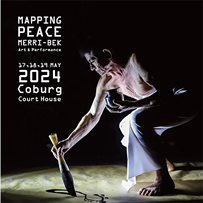
MAP PEACE
- Coburg Courthouse
- 13-18 May 2024
MAP EXPERIMENTUM

SELECTED HIGHLIGHTS
2023:
2021:
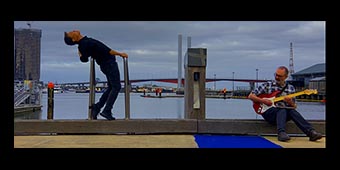
2020:
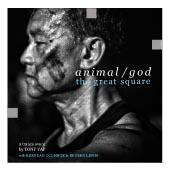
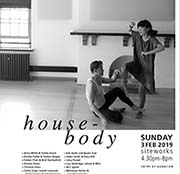
February 2019:
MAP MORELAND
past highlights:

5 mins video
Click on icon >
|
|
|
| |
|
|
Buddha Body Series
Rasa Sayang
Georgetown Festival, Penang Malaysia
Rasa Sayang dances the trace of something no longer present: the suspension of a sublime essence within the paradox of positive and negative form.
This compelling performance continues within the form of an extended installation established through Tony's long-term partnership with visual artist Naomi Ota and musicians Madeleine Flynn and Tim Humphrey.
More ...
5 mins video
Click on icon > > >
|
|
|
|
tyc past Events
- Dionysus Molecule
- Amber - Light in Winter Fest
|
|
|
| |
|
| |
|
| |
|
|